
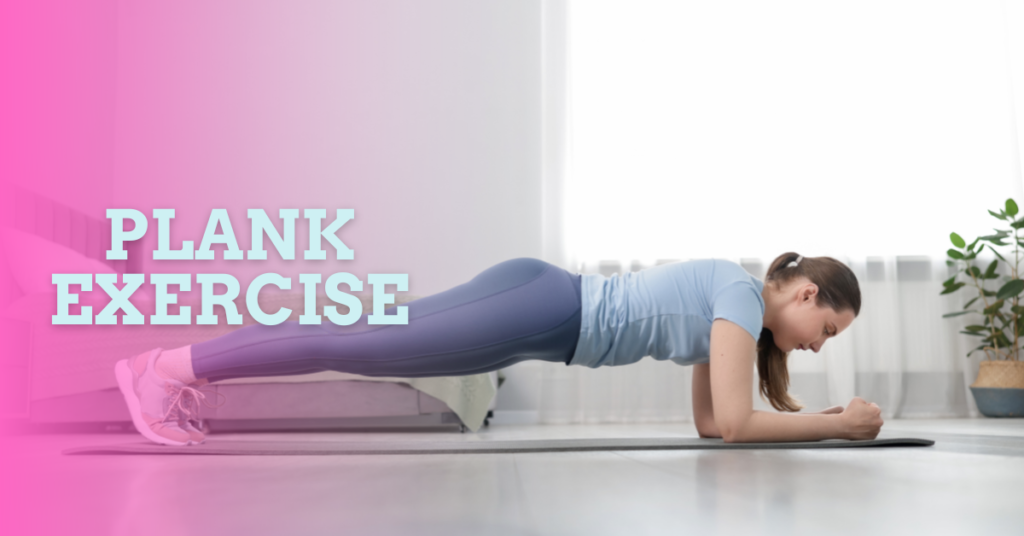
Ever wondered, “What muscles does a plank work”? The answer might surprise you, as most of us believe plank works on six-pack abs only.
While plank is one of the highly regarded core-strengthening exercise, it works on many other secondary muscles groups.
Hence, planks can be considered as a compound movement, as it requires multiple other muscles groups to perform it with a good form.
So, if you are also curious about, what muscles does a plank work, let’s know in this blog.

The Core Muscles: The Primary Target
It is widely known, core is the primary target muscle group that gets worked out by performing planks. But, in all honesty, core muscles itself consist of several muscles.
Therefore, let’s understand the core primary target muscle groups that activates by planks;
- Rectus Abdominis – This helps in stabilising torso and prevent lower back arching. This muscle is famously known as six-pack muscles.
- Transverse Abdominis – Transverse abdominis muscle is a deep underlying muscle and it looks like a natural weightlifting belt around the midsection area.
- Internal and External Obliques – Present at both the sides of the abdomen, they assist in stability and rotational (better read it twisting) movements.
These muscles work in tandem to keep your body elevated and in straight line from head to toe during planks.
Shoulders Work Harder than People Think
The engagement of shoulder muscle group is significantly higher than any other muscle group after the core in a plank position.
The entire body weight is put on hands or forearms in a plank hold; hence shoulder activation is natural.
The shoulder muscles which get involved are;
- Deltoids
- Rotator cuff muscles
- Serratus Anterior
Going forward, you will see what other muscle groups work out during a plank. Thus, you will understand why even a 20-30 seconds plank hold feels difficult.
The Involvement of Chest Muscles
Even though, plank is never known as a chest exercise, but chest muscles perform a supporting role in a plank position.
Both pectoralis major and minor muscles help in maintaining the upper-body stability when you perform high planks. You need to get into a push-up position and hold.
Even if the overall muscle activation is less, plank engage chest muscles.
How does the Back Muscle Contribute!
Maintaining a good posture is one of the inflexible requirements of doing a plank hold. And back muscles are engaged to keep the body posture stable during a plank.
A large part of the back muscles contribute in performing a plank, which are;
- Erector Spinae
- Latissimus Dorsi (Lats)
- Trapezius
Back help in keeping the spine straight and avoid bending towards the floor.
The role of Glutes and Hips Muscles
Squeezing of glutes improves the efficiency of planks. Many people already know it, but beginners on occasions are found to be surprised by this fact.
The glutes and hip muscles which get engaged in plank are;
- Gluteus Maximus
- Gluteus Medius
- Hip Stabilizers
These muscles prevent dropping of pelvis from a neutral position.
If your hips sag during a plank, it is an indication of poor glutes and core engagement.
Legs also have an Important Role to Play
Although legs remain static in plank exercise, it can’t be considered inactive. In a plank position, below leg muscles are engaged;
- Quadriceps
- Hamstrings
- Calves
Tightening of leg is inevitable during a plank; hence, the muscles highlighted above get proper activation.
Why Planks Feel Difficult
Plank is an isometric exercise; unlike other exercises it is performed by muscle contraction without any changes in the length.
Since, a multiple muscle groups are involved in performing this movement, body get fatigued sooner.
That is the reason even an experienced exerciser might find plank quite challenging.
How to Get the Most Out of a Plank
For a better muscle activation:
- Keep your body in a straight line.
- Tighten your abdominal muscles.
- Squeeze your glutes.
- Engage your thighs and calves.
- Avoid letting your hips sag or rise too high.
- Breathe normally throughout the hold.
Lesser time with proper form is way better than longer hold time with compromised muscle engagement.
Conclusion
Instead of asking, “what muscles does a plank work?” better way to frame this question is, “What muscles doesn’t it work?”
We learn that plank engage several muscle groups, i.e., shoulders, chest, back, glutes, hips, legs, and obviously the abdominal muscles.
Lastly, we can conclude that lesser time with good posture is way better than longer time with poor muscle engagement.
How long can you hold a plank! Comment your hold time below.

A former Army serviceman, I learned the value of discipline, resilience, and perseverance—qualities that continue to guide my life. My fitness journey sparked a passion for strength, mobility, nutrition, and overall wellness. Through my writing, I share practical, evidence-based fitness tips and workout guides to help readers lead healthier lives. Beyond fitness, I enjoy traveling and exploring new places, believing that both fitness and travel inspire confidence, growth, and lifelong adventure.
Pingback: Best Transverse Abdominis Exercises for Core Strength
Pingback: 40+ and Want to Stay Fit? These Bodyweight Exercises Actually Work
Pingback: Glute Bridge Core Bracing: Strengthen Your Core
Pingback: Why the Bird Dog Exercise Feels Harder Than It Looks
Pingback: 7-Day Beginner Yoga Plan for Strength and Flexibility